

Why is this? Personally, I find that thinking about God’s words and filtering His revelation to me through my mind feels a whole lot safer than letting them touch my inner self and provoke an emotional response. Sadly, I think that much of our relating to the Lord, and ministry to others, can easily become about the head rather than the heart.
But Christ knew that real inner transformation, deep heart yearning for repentance and humble delight in His salvation, would only come as we let go of our control and let ourselves come present to buried fear, despair, bitterness and shame.
This is why He spoke using the language of the heart: imagery.
And that same tool remains powerful today in the form of Christian allegory. An allegory is a story which reveals a deeper, hidden truth.
Jesus’s Use of Parables
The House on the Rock
Matthew 7:24-27; Luke 6:47-49
Jesus compares those who hear and act upon His word with a man who built his house upon the rock: when the storms and floods came, his house stood firm. Those who disregard the word of God are like the man who built his house upon the sand: it was utterly destroyed by the wind and rain.
This is a story to which every one of us can relate, the desire to build a little home being fundamental to every person’s life, even from childhood. Did you, like me, try to build a tree house in the garden, or create a secret place out of old furniture or throws?
The symbolism is simple, but also strikingly powerful. The walk of faith is something we build throughout our lives, each decision adding another brick to the structure. Only God’s word to us can be the bedrock for our building.
The man who built on the sand was looking for a quick and easier way to immediate results, one that didn’t require solid foundations. And the storms of life are always what test the lives we’ve built. Only the things we’ve created by faith, in God’s will, stand firm and give us the support we need when trials and suffering come.
The Hidden Treasure
Matthew 13:44
This simple parable sums up the calling of Christ in just one verse. Jesus compares the kingdom of heaven to a precious treasure buried in a field: the man who discovers that field sells all he has to own the land. The believer who truly loves the Lord will be willing to give up everything he has to discover the fullness of the kingdom of heaven.
And he will be willing to lay all these things at God’s feet just for the knowledge that one day he will discover the glory of his inheritance in Christ.
The image Jesus paints here is not one of a man who exchanges his life for a certainty: the treasure is hidden and not under his control. Instead, such is the devotion of the man, to pursue the kingdom of God at all costs, that he finds joy simply in the hope of it.
The Lost Coin
Luke 15:8-10
It is interesting to note that Christ’s allegories focus on different situations, so that every one of His hearers, of whichever age, background or gender, would find something they could identify with.
Here, a woman loses one of her ten silver coins and sweeps the house diligently until she finds it. Jesus compares her rejoicing with that of God’s angels rejoicing over the repentance of a single sinner.
The high value of a silver coin, especially to a woman who swept her own house instead of having servants to do it for her, represents the infinite value of a person. The fact that the one lost coin still matters, even though nine others remain, reminds us of the significance to the Lord of every individual who calls on His name. And the diligence of the woman’s sweeping is symbolic of God’s relentless and loving pursuit of the lost.
Well-Known Examples of Christian Allegory
Modern examples of extended parables, or allegorical stories, include the much-loved The Pilgrim’s Progress by John Bunyan, The Chronicles of Narnia by C.S. Lewis, and Hinds’ Feet on High Places by Hannah Hurnard.
The Power of Allegory to Touch the Heart
As well as drawing us into a story, allegory creates a mirror: it allows us to see ourselves and our weaknesses in the characters portrayed, without feeling judged.
Our minds are quick to analyse and create a defence when we’re presented with a truth which confronts our long-held misconceptions. If you’re anything like me, I can easily rationalise why an argument which makes me feel uncomfortable doesn’t apply to my situation!
But this is much harder to do with a story which unfolds gradually and engages the heart as it goes, each revelation of truth building on the last.
A good allegory also allows my heart to wrestle with truths which are much greater than my limited understanding can embrace. This is especially helpful with the Christian faith, which often presents eternal truths the fullness of which is beyond complete comprehension this side of heaven.
The truth we need to live by is simple, but some theological concepts are much greater than we can yet grasp.
Stories leave room for mystery.
How The Song of the Overcomer Uses Allegory and Symbolism
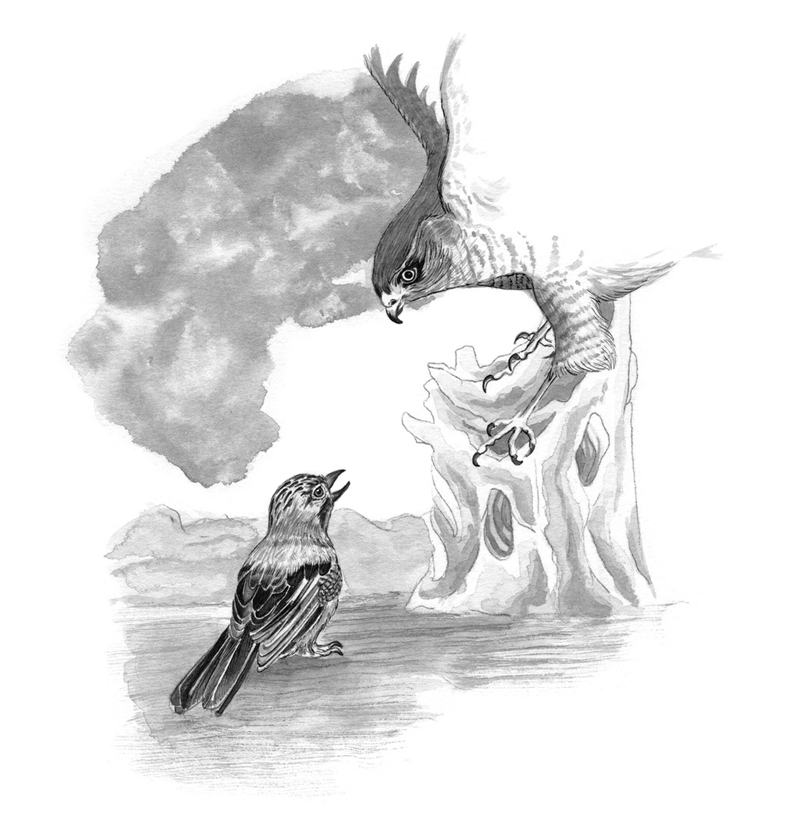
The Song of the Overcomer is a Christian allegory that bases its story around a community of birds in a farmhouse garden.
Each of the birds is true-to-life in its authentic appearance and behaviour, but I have created each character in such a way that their outward appearance also mirrors their soul. The birds symbolise elements of God’s truth and glory, or areas of apostasy and deception.
Robin is the main character, and his burning breast becomes a sign of his devotion. The natural appearance and behaviour of the other birds likewise become part of their characterization and symbolism.
Some of those connections are apparent from the beginning. Others are best discovered as the story unfolds.
You can discover more about the characters in [Meet the Birds] → Meet the Birds.
Let the Story Speak to Your Heart
Christian allegory can be an essential tool for unlocking the defended places in our hearts, the gates to which are kept shut by the comfort of relying on rational thought.
If you haven’t done so before, why not reread one or two of Christ’s parables, taking time to meditate on the stories and visualise yourself taking part in them?
Then invite the Lord to show you more details than you have seen so far, and to give you revelation as to their meaning.
If you would like to discover how allegory and symbolism are woven into a contemporary story, explore The Song of the Overcomer.